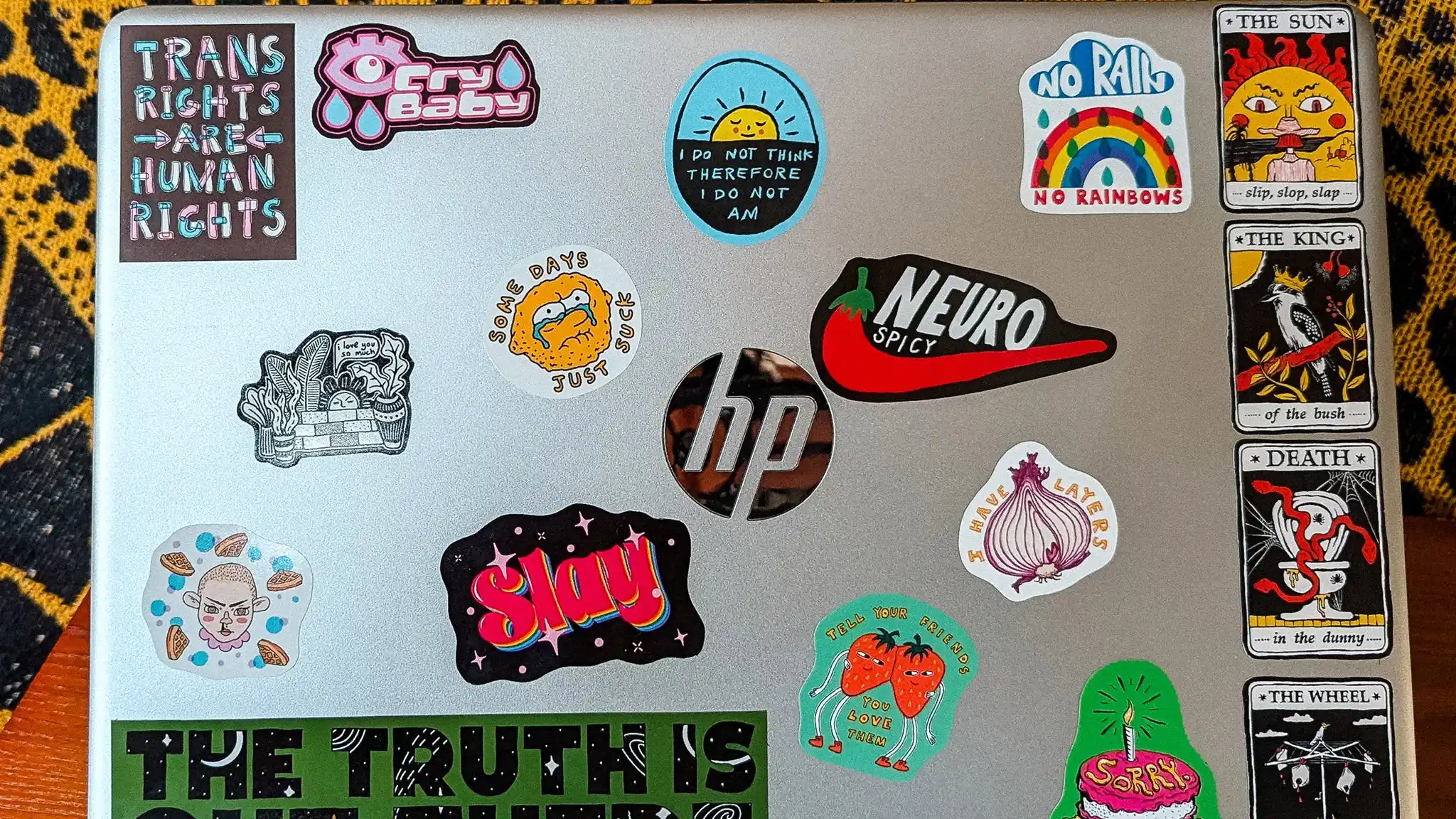
I’ve seen people get weirdly frustrated over one tiny thing: peeling a sticker. They love the design, they want to put it on a water bottle, and then they spend 30 seconds picking at a corner like they’re trying to open a stubborn bag of chips.
That’s usually not a “bad sticker” problem. It’s a cut style problem.
When you’re ordering custom stickers, the two most common options are die cut and kiss cut. Both can look great. But they work better in different situations.
What “die cut” and “kiss cut” actually mean
These terms describe how deep the blade cuts.
Die cut stickers are cut all the way through the sticker material and the backing paper (release liner). The sticker ends up as a standalone piece in the exact shape of your design. People also call this a contour cut because it follows the outline.
Kiss cut stickers are cut through the sticker layer, but not through the backing paper. The backing stays intact, so your sticker sits on a larger piece of backing. That extra border is the whole point.
If you only remember one thing, remember this:
- Die cut = cut through everything
- Kiss cut = cut through the sticker, not the liner
How they look and feel in your hand
This is where the difference becomes obvious.
Die cut: the “finished piece” look
Die cut stickers feel like a finished product right out of the box. No extra backing border around the design. Just the sticker in its final shape. This is why die cut is the default choice for logo stickers, laptop decals, and “one sticker per person” giveaways.
Kiss cut: the “easy peel” border
Kiss cut stickers feel more like a sticker mounted on a little backing card. That backing makes handling easier, especially for small sizes. It also protects edges while the sticker is still in the stack.
If you’re planning to hand these out at an event, or you’re including them as packaging inserts, that border can make life easier.
Peeling: which one is easier?
In a lot of real-world cases, kiss cut is easier to peel.
Why? Because you can hold the backing and lift the sticker without having to pinch at the actual sticker edge. That matters when:
- the sticker is small
- the shape has sharp points
- the design has thin lines
- you’re giving them to kids (or anyone impatient)
Die cut can still peel fine, especially in medium or large sizes. But if you’re doing tiny die cuts, expect at least a little “fingernail fight” sometimes.
Sticker sheets vs sticker packs
This is the fastest way to decide.
If you want a sticker sheet
Go kiss cut.
Kiss cutting is commonly used for sticker sheets because you can cut multiple designs on one page while the backing stays whole. That keeps the sheet intact and easy to store.
If you want individual stickers in a stack
Go die cut.
Die cut is what most people expect when they buy a “sticker pack” that’s a stack of separate stickers. It feels cleaner and more like merch.
Shipping and storage: what gets beat up in a mailer?
Kiss cut stickers have a built-in edge protector: the backing border.
That means:
- less edge curling in a loose stack
- less chance of a corner getting bent
- easier handling when you’re sorting, packing, or handing them out
Die cut stickers can ship perfectly too. They just need decent packaging so the exposed edges don’t get abused in transit.
If you’re sending a lot of freebies in envelopes and you want the least drama, kiss cut can be more forgiving.
Durability: cut style vs material
This part trips people up.
Die cut vs kiss cut does not automatically mean waterproof vs not waterproof. The cut style is about the blade depth, not the material.
Durability mostly depends on things like:
- vinyl vs sticker paper
- whether there’s a laminate
- how thick the sticker is
- how rough the use case is (water bottles, coolers, outdoor gear, etc.)
You can absolutely order kiss cut vinyl stickers. And you can order die cut stickers that are meant for indoor use. The cut style is a separate choice.
Design tips so the cutline doesn’t surprise you
You don’t need design skills to avoid common cut issues. You just need a few rules.
1) Thin edges are fragile
If your shape has skinny spikes, hairline text, or tiny “dangly bits,” it’s more likely to lift over time. That’s true for both cut types, but it’s more noticeable with die cut since the sticker is fully shaped.
2) A white border hides tiny shifts
A small white border (or any consistent border) makes the sticker look intentional and helps hide tiny cutting variations. It also makes photos pop.
3) Full bleed needs bleed
If you want color to go right to the edge (full bleed), your file needs bleed so you don’t end up with tiny white slivers on one side.
4) Small stickers often do better as kiss cut
If you’re ordering anything really small, kiss cut can save you from peel frustration. It’s also nice when you’re doing intricate shapes.
Cost: what usually changes
Pricing varies a lot by shop, quantity, and finish, so I won’t pretend there’s one universal rule. But a general pattern shows up across printers:
- Kiss cut can be more cost-effective in bulk, especially when produced on sheets.
- Die cut can cost more per sticker if the shape is complex or if the order is treated as individual pieces that need more finishing.
The practical takeaway is simple: if you’re ordering huge quantities for handouts or packaging inserts, ask yourself if kiss cut would do the job with less cost and less peel pain.
Which one should you choose?
Here are the most common “best fit” scenarios.
Choose die cut if you want:
- a standalone sticker that looks finished immediately
- clean, custom-shaped logo stickers
- sticker packs made of individual pieces
- a “merch” feel for laptops, bottles, helmets, or gear
Choose kiss cut if you want:
- sticker sheets (multiple designs on one sheet)
- easier peeling, especially for small sizes
- extra protection for edges in stacks
- packaging inserts that feel easy and clean
What i’d do for PureUtah-style uses
If you’re making stickers from Utah trip photos, trail icons, park maps, or little souvenir designs:
- One big statement sticker for a bottle or cooler: die cut.
- A sheet of small trip stickers for journals and kids: kiss cut.
- A stack of freebies for events: kiss cut if they’re small, die cut if they’re medium/large.
And if you don’t want to mess with cutlines, bleed, or test prints, you can upload your artwork or photos to YouStickers and choose die cut or kiss cut there. (Link in references.)
Conclusion
Die cut vs kiss cut stickers isn’t about which one is “better.” It’s about what you need.
If you want a clean, standalone sticker that feels like a finished product, pick die cut. If you want the easiest peel, edge protection, or sticker sheets, pick kiss cut.
Pick the cut style that matches how people will actually use the sticker. Your future self (and everyone’s fingernails) will thank you.
